
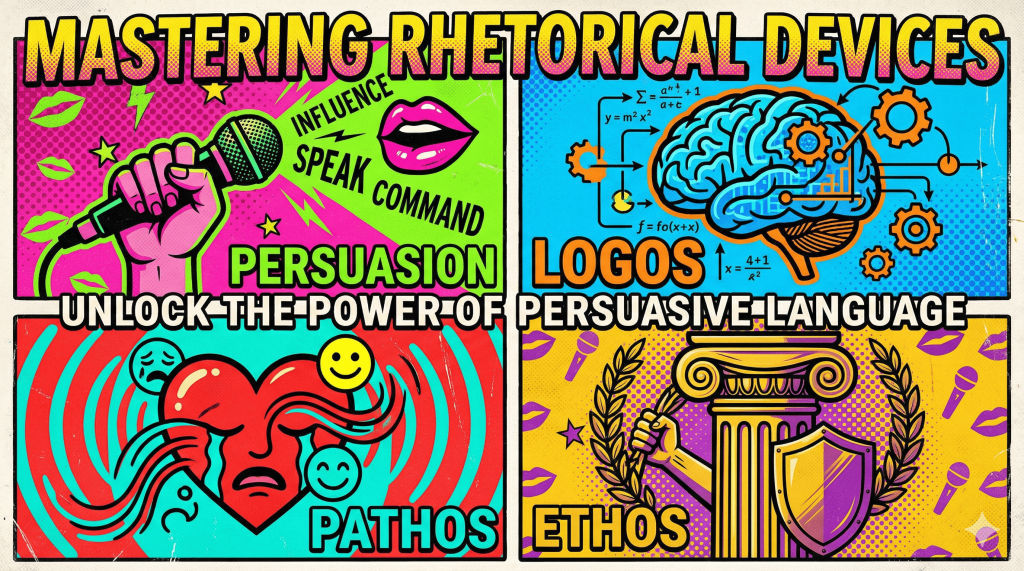
This article utilizes the SCQA Framework to establish context and the Minto Pyramid Principle to organize the hierarchy of ideas, ensuring that every rhetorical device discussed serves the overarching goal: moving an audience from apathy to action.
Executive Summary
In an era defined by information density and the rapid rise of AI-generated content, the ability to communicate with resonance is the ultimate competitive advantage. While data provides the “what,” rhetoric provides the “why.” By mastering the three pillars of persuasion—Ethos, Pathos, and Logos—and layering them with specific linguistic devices, leaders can transform dry information into a compelling narrative. This article breaks down the architecture of influence, providing a roadmap for applying classical rhetoric to modern contexts, from SaaS pitching to cinematic storytelling.
I. The SCQA Analysis: The Case for Rhetoric
The Situation (The Status Quo)
We live in a world of near-infinite connectivity. Whether you are building a SaaS application like Fabbrik, pitching a real estate portfolio in Central Europe, or crafting a cinematic script, your primary tool is language. Professionals today have access to more data and better tools than any generation in history.
The Complication (The Problem)
However, more information has led to less attention. The “noise floor” of digital communication is at an all-time high. Logic alone fails to move people; data without narrative is easily forgotten. Furthermore, the ubiquity of “standard” corporate language has made audiences cynical and immune to traditional marketing “speak.” The conflict lies in the gap between having a superior product or idea and the inability to make an audience care about it.
The Question (The Core Challenge)
How can a communicator bypass the cognitive filters of a modern, skeptical audience to deliver a message that is not only understood but acted upon?
The Answer (The Pyramid Peak)
The solution is the strategic application of Classical Rhetoric. By organizing communication through the Minto Pyramid Principle—starting with the conclusion and supporting it with structured rhetorical layers—you create a “persuasion engine” that appeals to the human brain’s evolutionary preference for pattern, emotion, and authority.
II. The Foundation: The Rhetorical Triangle
Before deploying specific devices, one must understand the three fundamental forces of persuasion. Without this balance, even the most poetic language will ring hollow.
Getty Images
1. Ethos: The Architecture of Credibility
Ethos is the “character” of the speaker. In the context of a startup founder or a digital agency owner, Ethos is established through professional history, the clarity of your vision, and the “moral” weight of your argument.
- Application: When discussing a brand like NQZ, Ethos isn’t just about the tech stack; it’s about the authority of the team solving the conversion intelligence problem.
2. Pathos: The Engine of Empathy
Pathos is the emotional connection. Humans do not make decisions based on logic; they justify emotional decisions with logic after the fact. Pathos bridges the gap between a “feature” and a “benefit.”
- Application: Instead of listing the specs of a real estate investment in Bratislava, focus on the security and legacy that tangible assets provide for a family’s future.
3. Logos: The Structure of Reason
Logos is the logical proof. This is where the Minto Pyramid Principle shines. It is the evidence, the statistics, and the deductive reasoning that make your conclusion feel inevitable.
III. The Arsenal: Key Rhetorical Devices for Modern Leaders
To move from the foundation to the “pyramid” of your argument, you must employ specific devices that create rhythm, clarity, and memorability.
1. Devices of Order and Emphasis
| Device | Definition | Example in Practice |
| Anaphora | Repeating a word at the beginning of successive clauses. | “We will build for the user. We will build for the future. We will build for the truth.” |
| Hypophora | Asking a question and immediately answering it. | “Why does e-invoicing matter now? Because compliance is the new currency of trust.” |
| Tricolon | A series of three parallel words or phrases. | “Clean code, clear vision, constant growth.” |
2. Devices of Perspective and Logic
These devices help reframe a situation, making a complex problem (the “Complication”) seem solvable (the “Answer”).
- Chiasmus (The Mirror): Reversing the order of words in two parallel phrases.
- Example: “Don’t just build a business for the technology; build the technology for the business.”
- Antithesis (The Contrast): Juxtaposing two opposing ideas to highlight a clear choice.
- Example: “We offer a solution that is global in its reach, yet local in its compliance.”
3. The “Cinematic” Devices of Imagination
For those involved in visual storytelling or brand advocacy, language must evoke imagery.
- Metaphor: Describing an abstract concept (like an AI SaaS) through a physical one.
- Example: “NQZ isn’t just an analytics tool; it’s a high-definition lens for your marketing blind spots.”
- Kairos: Seizing the “opportune moment.” In rhetoric, this is the art of saying the right thing at the exactly right time.
- Example: Addressing e-invoicing mandates just as a new EU regulation is announced.
IV. The Minto Hierarchy of Persuasion
To ensure these devices don’t become “clutter,” we organize them using the Minto Pyramid Principle. This ensures the most important information is at the top, supported by logical clusters.
Level 1: The Core Thesis (The Peak)
- Statement: Persuasion is a skill that can be engineered, not a talent one is born with.
Level 2: Supporting Arguments (The Pillars)
- Rhetoric provides structure: It prevents “rambling” and ensures every word serves the goal.
- Rhetoric builds trust: Through Ethos, you prove you are the right person to solve the problem.
- Rhetoric drives action: Through Pathos and Kairos, you create the urgency required for a “Yes.”
Level 3: The Evidence (The Base)
- Case studies of successful SaaS pitches.
- The historical impact of the “Rule of Three” in political speeches.
- The neurobiology of storytelling (how oxytocin is released during emotional narratives).
V. Application: From Script to Scale
How do these classical tools apply to your current projects?
In SaaS Development (e.g., Fabbrik/NQZ)
When pitching a technical product, developers often fall into the “Logos Trap”—providing too much data and not enough Ethos.
- The Shift: Use Hypophora to voice the user’s secret frustrations. “Is your data actually telling you the truth? Most founders don’t know. NQZ was built because we needed to know.”
In Real Estate and Consulting
When dealing with tax residency or cross-border investments (India to Slovakia), the “Complication” is often fear of complexity.
- The Shift: Use Anaphora to provide a sense of stability. “One partner for your legal needs. One partner for your tax needs. One partner for your peace of mind.”
VI. Conclusion: The Responsibility of the Rhetorician
Mastering these devices is like mastering a cinematic camera lens; it allows you to control where the audience looks and how they feel. However, the most powerful rhetorical device of all is Sincerity.
In the framework of the Minto Pyramid, your “Answer” must be true. If the logic is sound, the Ethos is earned, and the Pathos is genuine, rhetorical devices are not “tricks”—they are the bridge that allows your best ideas to reach the people who need them most.
Whether you are writing a blog post, a film script, or a business proposal, remember: Logic opens the mind, but rhetoric opens the door.
How would you like to see these rhetorical devices applied to a specific piece of content you’re working on, such as a landing page or a pitch deck?

Leave a comment